
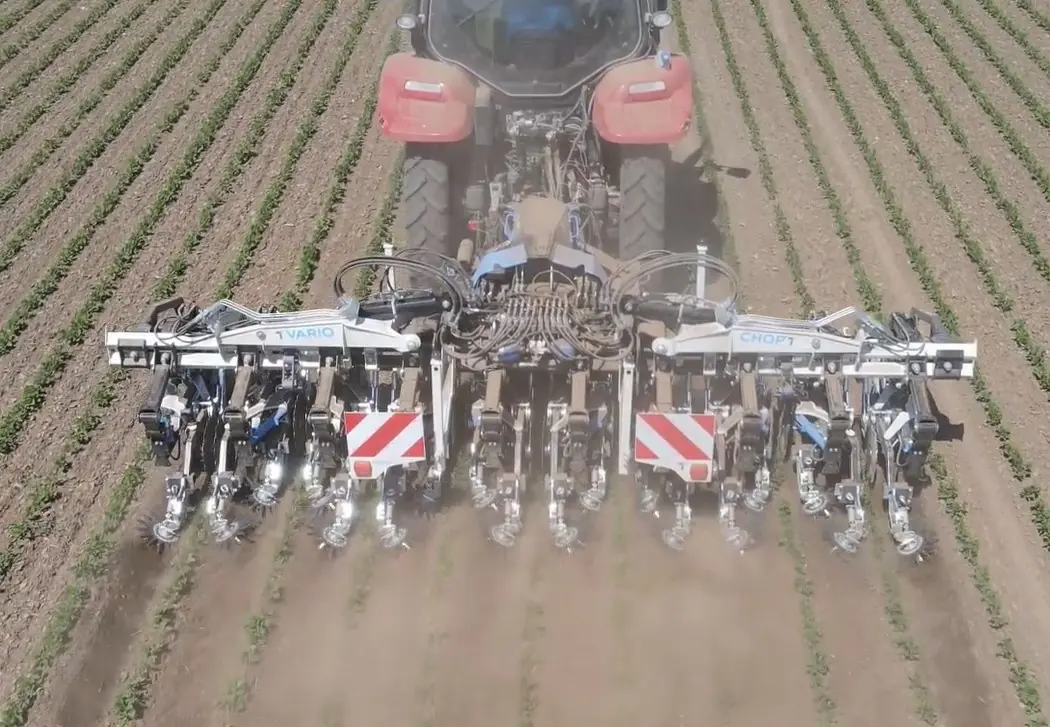
Anyone still weeding by hand in the field knows the problem: the days are long, labor is expensive and hard to find, and at the end of the season you wonder whether all the effort really pays off. In this article we take an honest look at how much time and how much money a modern inter-row cultivator actually saves compared to hand weeding – with concrete figures from practice.
How fast is a cultivator compared to hand weeding?
A person working with a hoe in hand manages – depending on crop and soil conditions – roughly 50 to 150 square meters per hour. That sounds like a lot, but for one hectare (10,000 m²) it still means a full day of hard work per person.
A mechanical cultivator such as the VarioCHOP operates at a working width of 3 meters and speeds of up to 19 km/h. In realistic field conditions, including headland turns, this results in a work rate of roughly 3 to 5 hectares per hour.
With a 6-row AI-controlled version (in-row hoeing included), speeds of up to 5 km/h can be achieved in sugar beet – around 1 hectare per hour – with no follow-up hand work in the row.
What does an hour of hand labor cost – and what does an hour of cultivator work cost?
The full cost of a farm laborer in Austria and Germany, including non-wage labor costs, is usually between 15 and 22 euros per hour. For seasonal peak labor, even higher rates are common.
A cultivator, on the other hand, mainly incurs machine costs: depreciation, fuel for the tractor, one operator and occasional maintenance. Per hectare, this amounts to between 25 and 50 euros depending on farm size – including tractor and driver.
Run the numbers and the following picture emerges for one hectare of sugar beet with three passes:
- Hand weeding: 60 to 90 working hours per hectare and season, depending on weed pressure – that is 900 to 2,000 euros in labor costs alone per hectare.
- Mechanical cultivator: 3 to 5 machine hours per hectare and season – around 75 to 250 euros per hectare.
- AI cultivator with in-row hoeing: Reduces the need for follow-up hand weeding by up to 90 percent.
The time factor: what does this mean in the daily routine?
A farm managing 20 hectares of row crops would, with hand labor alone, need two to three people in the field every day for three to four weeks – right in the main growing season, when the weeds never take a break.
With a modern cultivator, one person covers the same area in two to three days. That means: more time for the harvest, more time for repairs, more time for the family. And above all: the cultivator can run exactly when the weeds are small and the weather is right – not only when labor finally becomes available.
Where hand weeding still has its place
It rarely works entirely without hand labor. On very small plots, on extreme slopes or in specialty crops such as high-value vegetables on small beds, the hand hoe remains an important tool. It is also unbeatable for touching up individual spots.
Most farms, however, benefit from a combination: the cultivator handles 90 to 100 percent of the area quickly and reliably, while hand labor concentrates on the last 10 percent where it is really needed.
When does a cultivator pay for itself?
The rule of thumb from practice: from around 15 to 25 hectares of row crops per year, owning a cultivator clearly pays off compared to hand labor alone – provided you farm the area yourself and actually use the implement for several passes per season.
For smaller areas, shared use across farms (machinery cooperatives, contractors) or a used implement can be worth considering. For many farms, investment subsidies are also an important lever to make the purchase economical more quickly.
Frequently asked questions
How many hours of hand labor does a 6-row AI cultivator replace?
Under favorable conditions, a 6-row AI cultivator can replace the work of up to 60 laborers – above all where follow-up hand weeding in the row used to be necessary.
Is a cultivator worthwhile for organic farms too?
Especially for organic farms, which are not allowed to use herbicides, mechanical hoeing is often the only economical solution for larger areas. Here the time savings are particularly valuable.
How fast is a cultivator in the field?
Modern cultivators such as the VarioCHOP work at up to 19 km/h. The actual work rate – including headland turns – is 3 to 5 hectares per hour.
See for yourself instead of just calculating
Numbers are one thing, your own field is another. If you want to know how a cultivator performs on your crop and your soils, the best way is to attend a live demonstration. There you can see how fast, how clean and how low-maintenance modern hoeing technology really is – and whether the step from manual labor to machine pays off on your farm.