
Mechanical weeding is not a one-size-fits-all job – depending on the crop, row spacing and growth stage, the demands on the cultivator, its settings and the timing differ considerably. This practical guide gives a general overview of how farmers can adapt their inter-row cultivator to the most important arable crops.
The basic principle: why crop-specific hoeing matters
Every crop plant responds differently to mechanical soil cultivation. While some crops tolerate deep hoeing close to the row very well, others – especially in their early juvenile stage – are highly sensitive to being buried or damaged. Knowing and respecting these differences leads to better hoeing results and protects your yield.
Hoeing in corn
Corn is considered a classic row crop for hoeing. The row spacing of around 70–75 cm common in Austria and Germany leaves plenty of room for wide share systems that work the area between the rows effectively. As a general rule, start as early as possible – as soon as the weeds are at the seedling stage and the corn plants are standing firmly enough. Several passes during the juvenile stage are usually more effective than a single late one.
At a later stage, ridging soil up against the plant rows can further reduce weed pressure. Camera-guided cultivators allow working very close to the crop row.
Hoeing in sugar beet
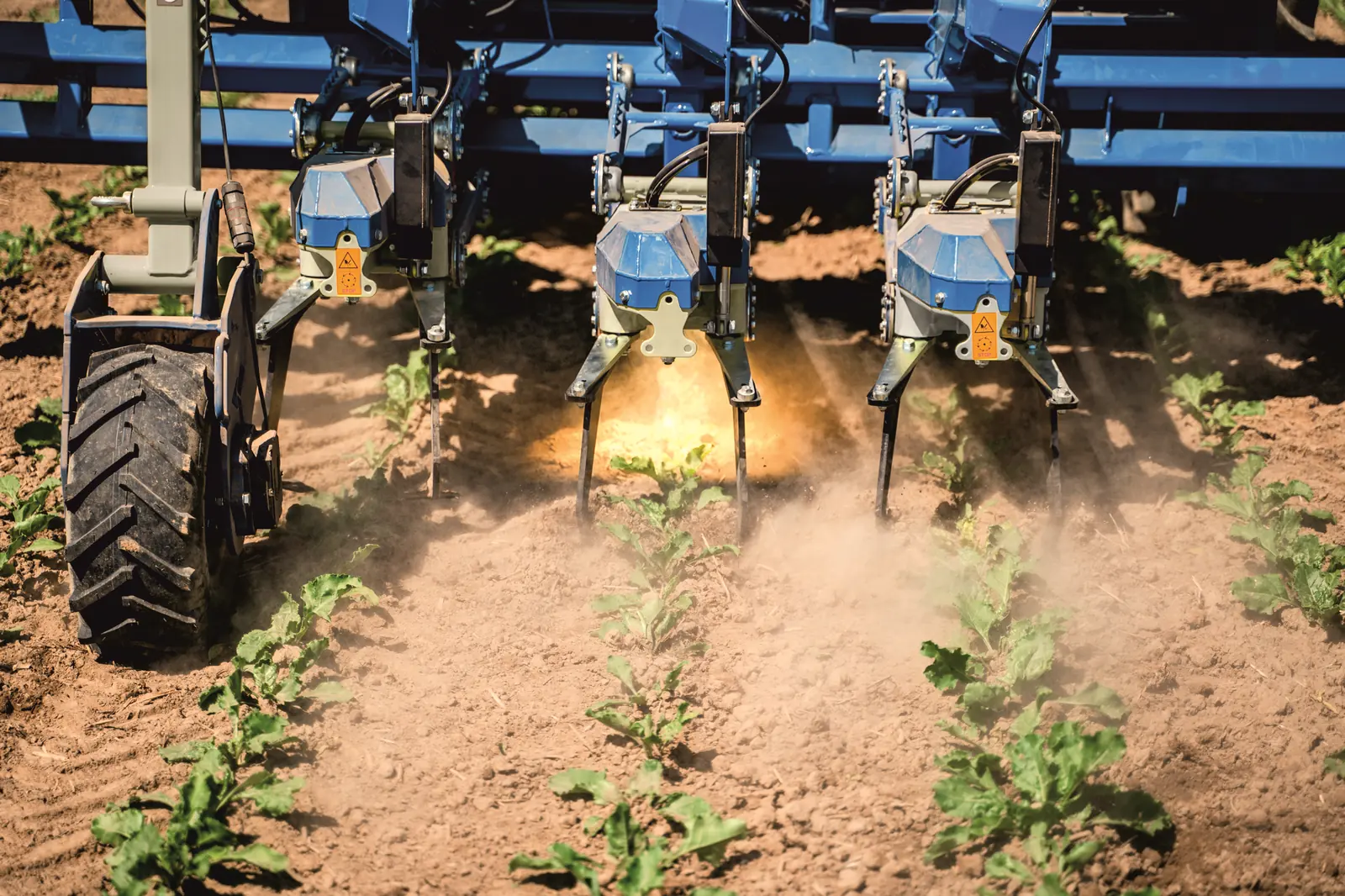
Sugar beet is one of the more demanding crops to hoe. In the early juvenile stage the plants are delicate – precise guidance of the shares is therefore particularly important. Weeds should be tackled early and consistently, since later hoeing passes are far less effective.
Narrow share units and precise guidance systems are especially in demand in sugar beet. Finger weeders or similar specialised tools make it possible to work close to the row without crop losses.
Hoeing in soybeans
Soybeans grow relatively slowly in the juvenile stage, which can give weeds a head start. That makes early hoeing particularly important. Many farmers rely on several hoeing passes, starting shortly after the crop emerges.
With narrower row spacing – as is sometimes chosen in soybean cultivation – slim, well-guided share units or camera-guided systems are recommended, as they stay in the row even on slight curves.
Hoeing in vegetables
In vegetable production, cultivators are particularly valuable because very few approved herbicides are available for many vegetable crops. At the same time, row spacings are narrower and the plants are often more sensitive than in arable farming.
Compact share units, rolling hoes or tine hoes are used here. Camera-guided cultivators can work precisely even with irregular plant distribution and are therefore especially interesting for organic vegetable farms.
One cultivator for several crops?
Modern, adjustable cultivators can be used across different crops without time-consuming conversion work. Flexible row-width adjustment – as on the VarioCHOP from SAMO – turns the machine into an all-rounder for farms with a diverse crop rotation. That saves money and increases the machine's utilisation over the whole season.
Conclusion
Using your cultivator in a crop-specific way – with the right shares, at the right time and with the right settings – delivers significantly better results. The combination of good equipment, correct timing and a bit of experience is the key to success in mechanical crop protection.
Questions about configuring your cultivator for specific crops? The SAMO team will be happy to advise you.