
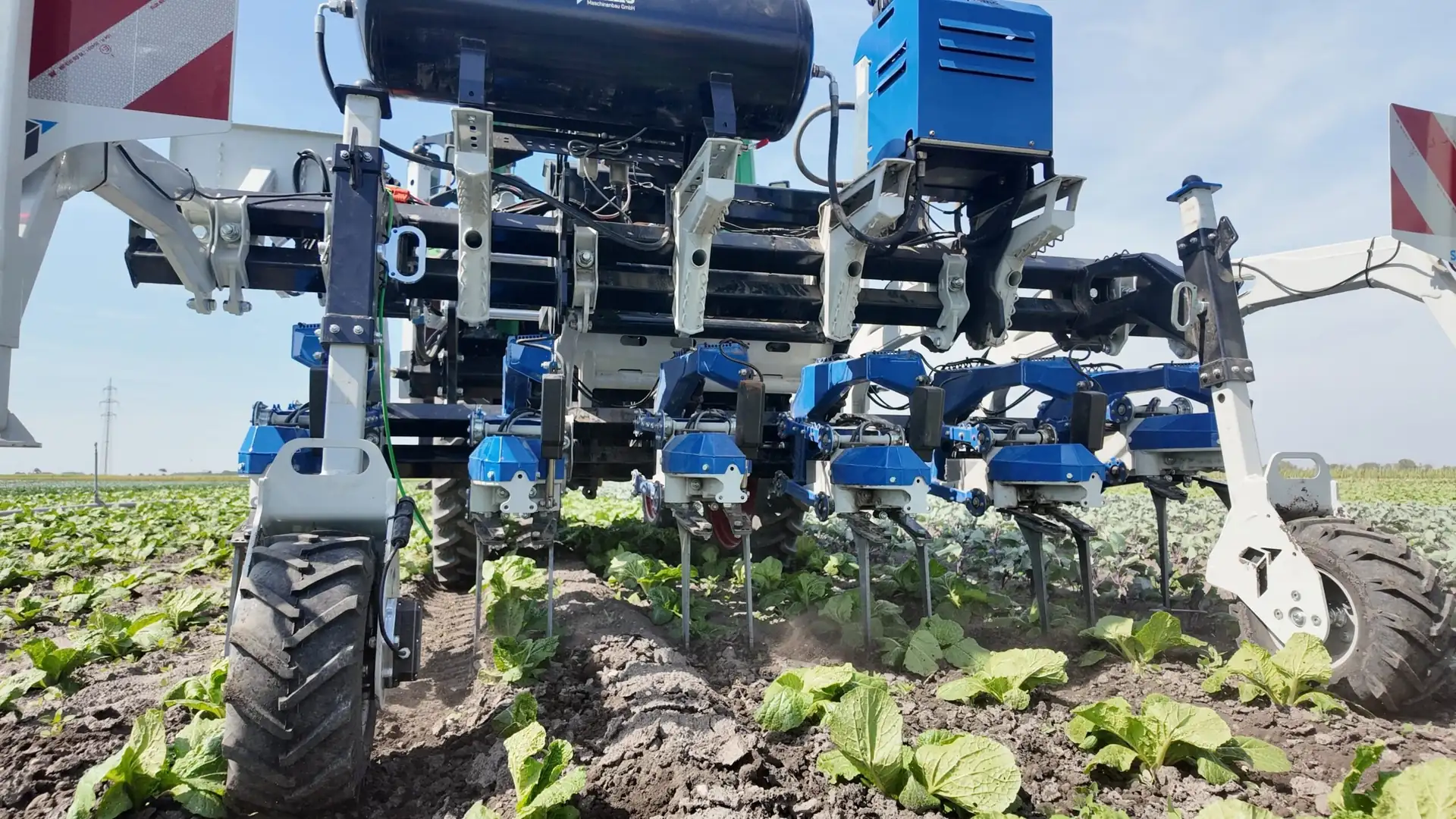
Organic farming without herbicides sounds simple – but in practice it is one of the biggest challenges any organic farm faces. If you are not allowed to spray, you have to tackle weeds differently: with the right plan, the right technology and a good feel for the right timing. This article shows how weed control on an organic farm works in practice.
Why weed control matters so much on organic farms
In conventional farming, weeds can be kept in check with herbicides. In organic farming, that route is closed. If weeds are left standing, they compete with the crop for light, water and nutrients – and the yield losses can be dramatic. Studies show that in corn, sugar beet or soybeans, 50 to 80 percent of the yield can be lost without weed control.
At the same time, manual labour is expensive and farm workers are hard to find. For many organic farms, a well-planned combination of preventive measures and mechanical hoeing technology is therefore the key to profitable production.
Step 1: Prevention – before the weeds even appear
The best form of control is the one that never becomes necessary. On an organic farm, weed control starts long before sowing:
- Crop rotation: A diverse rotation that alternates between spring and winter crops, dense and open stands, interrupts the life cycle of many weeds.
- Cover crops: Well-established cover crops shade the soil, draw water and nutrients and leave weeds hardly any chance.
- False seedbed: Preparing the seedbed two to three weeks before actual sowing lets part of the weed seed bank germinate early – so it can be taken out with the tine harrow before the crop goes in.
- Sowing date: Sowing later, at warmer temperatures, lets the crop emerge faster and outcompete the weeds.
Step 2: Tine harrowing – the first mechanical tool
In organic farming, the tine harrow is often the first implement to reach the field. It works across the whole surface and removes young weeds at the white-thread stage – before they are even visible. The right setting is crucial: aggressive enough to catch the weeds, yet gentle enough not to damage the crop.
Tine harrowing works particularly well in corn, soybeans, cereals and some vegetable crops. Two to three passes in the first weeks after sowing can already reduce weed pressure considerably.
Step 3: Hoeing – between the rows and in the row
As soon as the crop is standing in rows and is tall enough, the inter-row cultivator comes into play. Modern cultivators such as the VarioCHOP work with precise hoeing shares to centimetre accuracy along the plant row – saving manual labour and protecting the crop.
Two zones need to be distinguished:
- Between the rows: This is where the classic inter-row cultivator does most of the work. With the right hoeing share and working depth, it cuts off weeds and loosens the soil at the same time.
- In the row: This zone is considerably more difficult. For a long time, hand weeding was the only option here. Today there are camera-guided and AI-controlled solutions such as the VarioCHOP AI that detect weeds directly between the plants and remove them with precision.
Covering both zones in a single pass cuts hand-weeding costs massively – in practice by up to 90 percent.
Step 4: Finding the right timing
Success in organic farming stands or falls with timing. Weeds are at their weakest at the germination and white-thread stage. If you are three days late, you are already fighting established plants that are far harder to control.
This leads to an important conclusion: organic farms need hoeing technology that is ready to go at any time and adapts quickly to changing conditions. The band width adjustment of modern cultivators – electro-hydraulic or mechanical – is a decisive advantage here: instead of converting the machine, the driver simply changes the hoeing width in seconds.
Practical examples: which crops benefit most?
Organic hoeing technology is used in almost every crop today. It has proven especially successful in:
- Corn and soybeans: Classic organic row crops in which tine harrow and inter-row cultivator work together superbly.
- Sugar beet: In-row hoeing is particularly valuable here because the plants stay small for a long time.
- Pumpkin: Can be hoed several times until the canopy closes.
- Vegetables such as fennel, lettuce and cabbage: Precise implements with a camera system are indispensable here.
- Herbs: High-value crops where every plant counts – modern AI hoeing technology works reliably here.
Frequently asked questions
Is tine harrowing alone enough for weed control in organic farming?
Tine harrowing is an important building block, but in most row crops it is not enough on its own. A combination of tine harrow and inter-row cultivator – ideally with an in-row function – delivers the best results.
When is the best time to hoe on an organic farm?
At the white-thread stage of the weeds and in dry, sunny weather. Dry days after hoeing ensure that the uprooted weeds wither instead of rooting again.
Can AI hoeing technology be used in organic farming?
Yes – AI-guided cultivators are in fact particularly valuable in organic farming because they make hoeing in the row possible, replacing expensive hand weeding.
Finding the right approach for your own farm
Every farm is different – soil type, crops, row spacings and weed pressure all vary. If you are considering an investment in modern hoeing technology, you should definitely see the machines working live. A field demonstration is the best way to judge what really makes sense on your own farm – and which combination of tine harrow, inter-row cultivator and AI technology delivers the greatest benefit.