
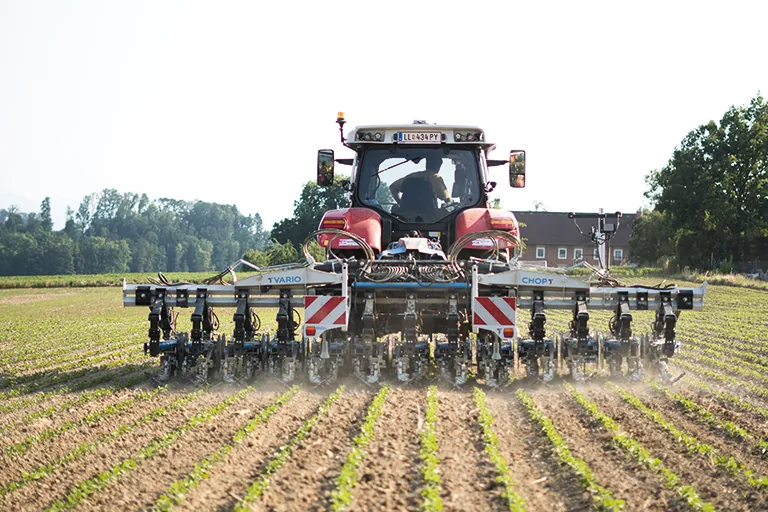
Sooner or later, anyone buying an inter-row cultivator faces the important question: which row spacing actually suits my crop? The choice is far from trivial – it affects yield, soil cultivation, plant health and, in the end, profitability. This article gives a practical overview of which row spacing is common for which crop and what matters when choosing.
What is row spacing anyway – and why is it so important?
Row spacing is the distance between two adjacent crop rows in the field. It determines how many plants stand per hectare, how much space each plant has – and above all, how much working space inter-row cultivators have between the rows.
Row spacing that is too narrow makes mechanical hoeing difficult and can reduce light penetration. Spacing that is too wide wastes area and leaves more room for weeds. The art lies in finding the right balance – and that depends heavily on the crop.
Common row spacings by crop
Here is a practical overview of the most common row spacings in Austria and Germany:
Corn: 70 to 75 cm
Corn is traditionally grown in 75 cm rows. This width has proven itself because it offers enough space for the vigorous plants while leaving cultivators plenty of room to work. Some farms opt for 70 cm to achieve slightly denser stands.
Sugar beet: 45 to 50 cm
Sugar beet traditionally stands in 45 cm rows. This narrow spacing makes mechanical hoeing more difficult because there is little space between the rows – modern cultivators with precise shares and camera control are indispensable here.
Soybean: 30 to 45 cm
With soybeans, row spacings vary widely – between 30 cm (dense drilling) and 45 cm (classic precision single-seed sowing). Those who want to work with a cultivator usually go for 37.5 cm or 45 cm.
Sunflower: 50 to 75 cm
Sunflowers are grown in 50 to 75 cm rows depending on region and variety. Where shorter varieties are chosen, planting is often narrower; with tall-growing standard varieties, wider.
Pumpkin: 100 to 200 cm
Oil pumpkin needs considerably more space – row spacings of 140 to 200 cm are common. Culinary pumpkins often stand in 100 to 150 cm rows. Here the hoeing width is particularly large and the cultivator has plenty of room.
Vegetables (lettuce, fennel, cabbage): 30 to 50 cm
In field vegetables, spacings vary greatly with the crop. Lettuce and fennel often stand in 30 to 40 cm rows, cabbage crops in 45 to 60 cm. Precise hoeing technology with a camera system is standard here.
Cereals (row drilling with hoeing): 12.5 to 25 cm
Conventionally drilled cereals stand in 12.5 cm rows – too narrow for hoeing. Those who want to hoe cereals use wide-row seeding at 25 cm or more.
One implement for all row widths?
For a long time, the rule was: one cultivator per row spacing – or at least hours of conversion work before every new crop. That has changed. Modern cultivators such as the VarioCHOP are equipped with a patented band width adjustment that can be changed electro-hydraulically from the cab or mechanically in next to no time.
The new X-ADJUST system takes this one step further: any row width between 45 cm and 75 cm can be adjusted steplessly and hydraulically – within seconds. Instead of several implements for different crops, a single cultivator covers the entire farm.
What else matters when choosing
Beyond row spacing, other factors come into play:
- Soil characteristics: On heavy soils, slightly wider rows often make sense to avoid crusting.
- Crop sequence: Farms that regularly alternate between similar crops (corn and soybean, sugar beet and corn) can often choose a uniform row spacing.
- Harvesting and seeding technology: The row spacing must match the seeder and the harvester. If you run a six-row seeder, you should choose a matching cultivator.
- Camera guidance and AI: Narrower rows benefit particularly strongly from camera-guided steering and AI systems, because precise work right at the plant is decisive here.
Frequently asked questions
What is the optimal row spacing for corn?
In Austria and Germany, 75 cm row spacing is the standard for corn. Some farms also work with 70 cm to achieve denser stands.
Can I hoe 45 cm sugar beet and 75 cm corn with the same cultivator?
Yes, with modern cultivators such as the VarioCHOP X-ADJUST this is no problem at all. The stepless band width adjustment allows switching between crops in a matter of seconds – without conversion work.
Are narrow rows worthwhile in organic farming?
Narrow rows shade the soil faster and suppress weeds naturally. However, they require precise hoeing technology, ideally with camera control or AI for in-row hoeing.
Finding the right row spacing for your farm
Which row spacing suits your farm depends on your cropping plan, your seeding technology and the hoeing technology available. The best way to judge is in practice – at a field demonstration you can see how flexibly modern cultivators handle different crops and row widths today. If you are looking for one implement for all crops, the VarioCHOP with its band width adjustment is a sound choice.