
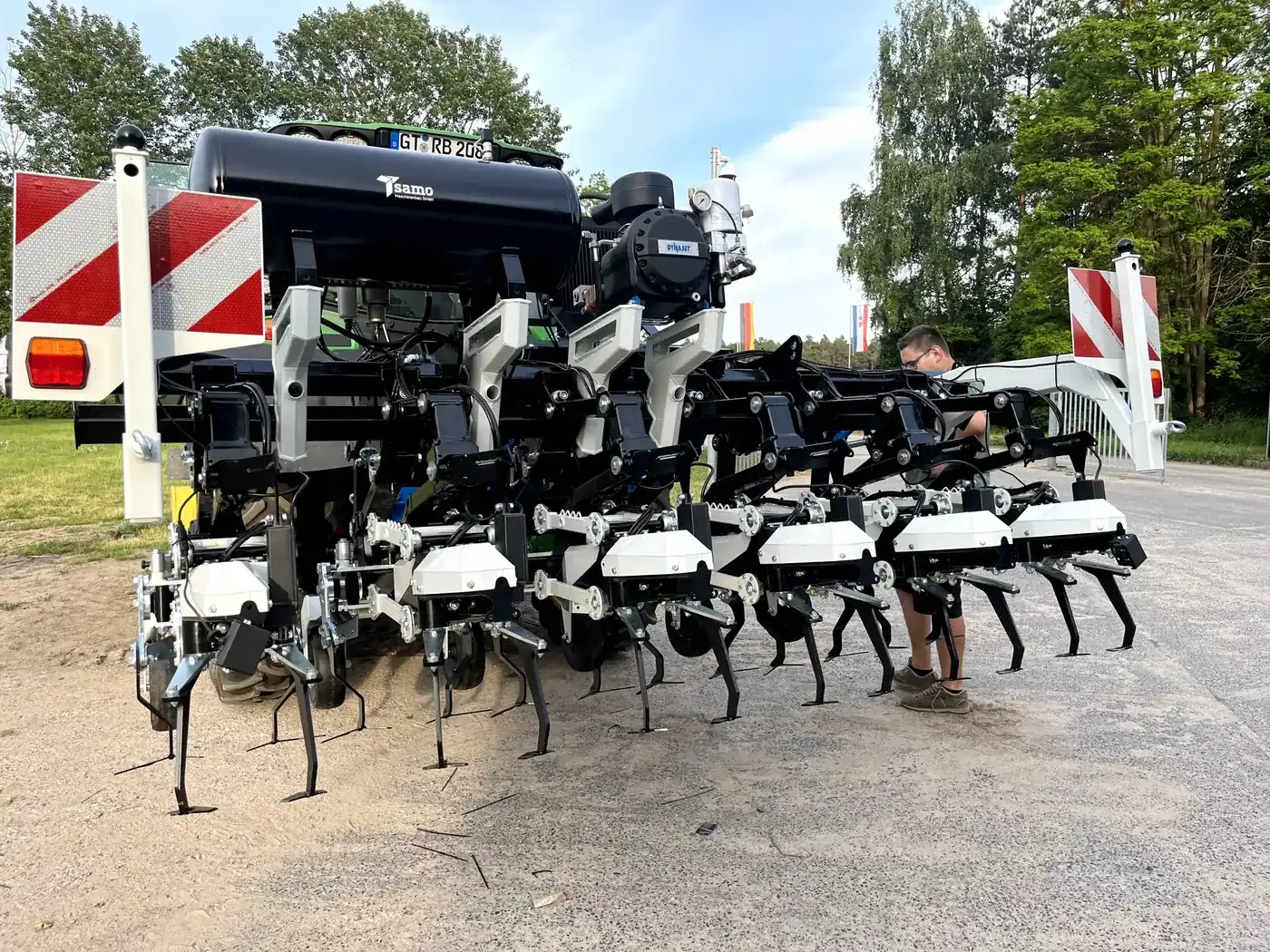
An inter-row cultivator stays on a farm for ten years or more. The choice is correspondingly wide – from a simple rigid-frame machine to camera-guided cultivators and AI hoes that work inside the row. This guide sorts the machine types, shows what matters when buying used, which row configuration fits which farm, and what actually drives the price. It is deliberately written to be useful even if you end up buying somewhere other than SAMO.
Why cultivators are on so many farms' shopping lists right now
Growing pressure on certain herbicides has clearly increased interest in mechanical weed control, while demands on sustainability and biodiversity in arable farming keep rising. For organic farms and for conventional farms pursuing a herbicide-reduction strategy, an inter-row cultivator is now a core implement rather than a niche machine.
Labor is the second driver. Hand weeding in the row is expensive and, during the main growing season, almost impossible to plan. The scale of the difference is set out in our comparison of cultivator versus hand weeding: one person with a hoe manages roughly 50 to 150 square meters per hour, while a mechanical cultivator with a 3-meter working width reaches about 3 to 5 hectares per hour in the field, headland turns included.
Used correctly, a modern hoeing machine substantially reduces herbicide use – often while improving soil structure, because shallow cultivation breaks the capillarity and stimulates soil organisms.
The three machine types – and what each is good for
1. Standard cultivator working between the rows
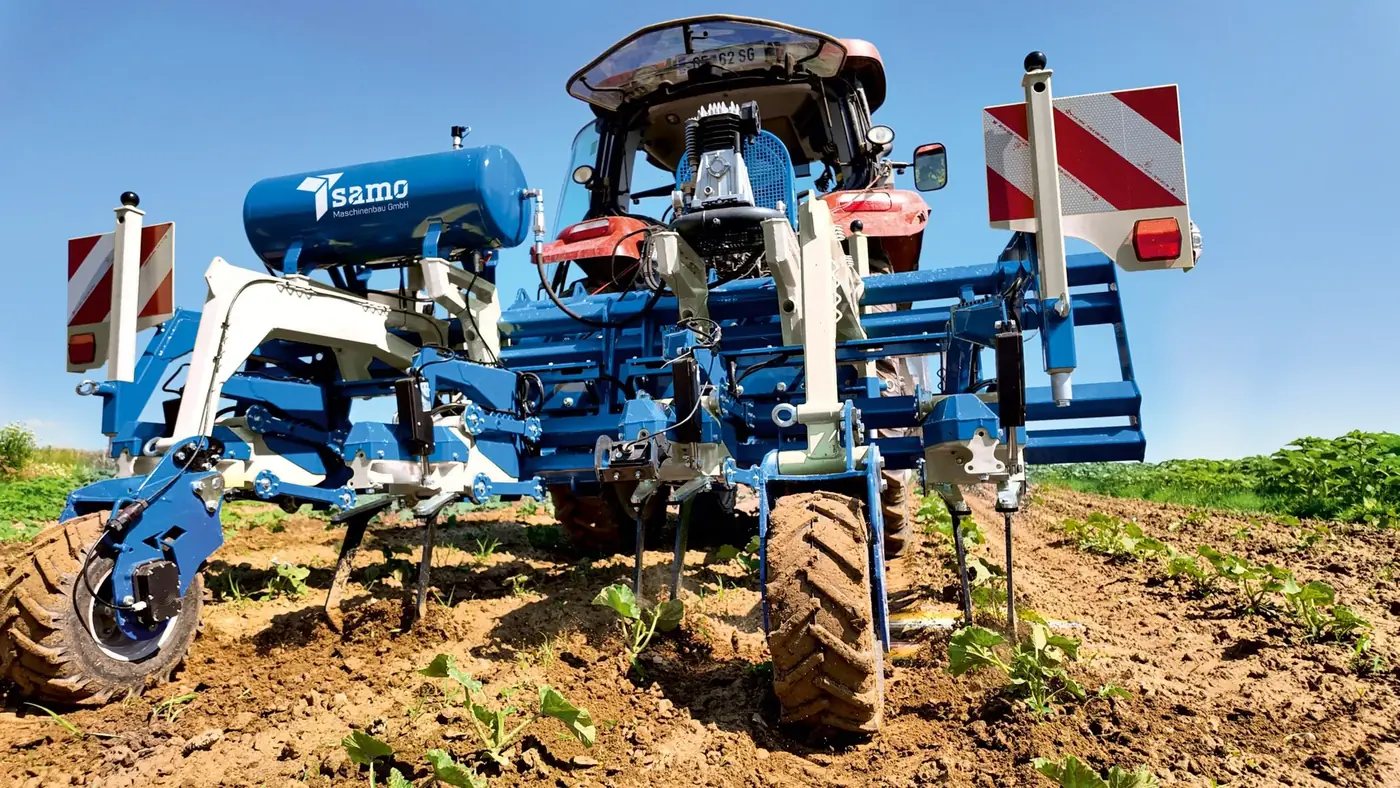
The classic cultivator works the soil between the crop rows. It is guided mechanically – by flange wheels, feelers or the driver. Parallelogram designs, in which each row unit is suspended individually and follows the ground contour, are widespread; rigid-frame machines are a more compact and usually more affordable alternative on level ground.
What separates machines in this class is how close to the plant they can work and how quickly they can be converted. On the SAMO VarioCHOP this is handled by the patented band width adjustment: the hoeing band width can be changed electrohydraulically straight from the cab, or mechanically in very little time, and working speeds of up to 19 km/h are possible. The X-ADJUST system additionally converts any row width from 45 to 75 cm hydraulically and infinitely variably.
2. Camera-guided cultivator working between the rows
Here a camera takes over row guidance. The image processing system detects the crop row and controls a side-shift frame that keeps the implement on track. The benefit shows up with narrow row spacings, at higher speeds and wherever the driver would otherwise have to correct constantly. The VarioCHOP is explicitly designed to be combined with a camera system and can also be combined with Section Control.
One point of clarity: a camera between the rows guides the implement more accurately – it does not hoe inside the row. Weeds standing directly between two crop plants remain unless finger weeders or ridging discs run alongside.
3. In-row cultivator with AI
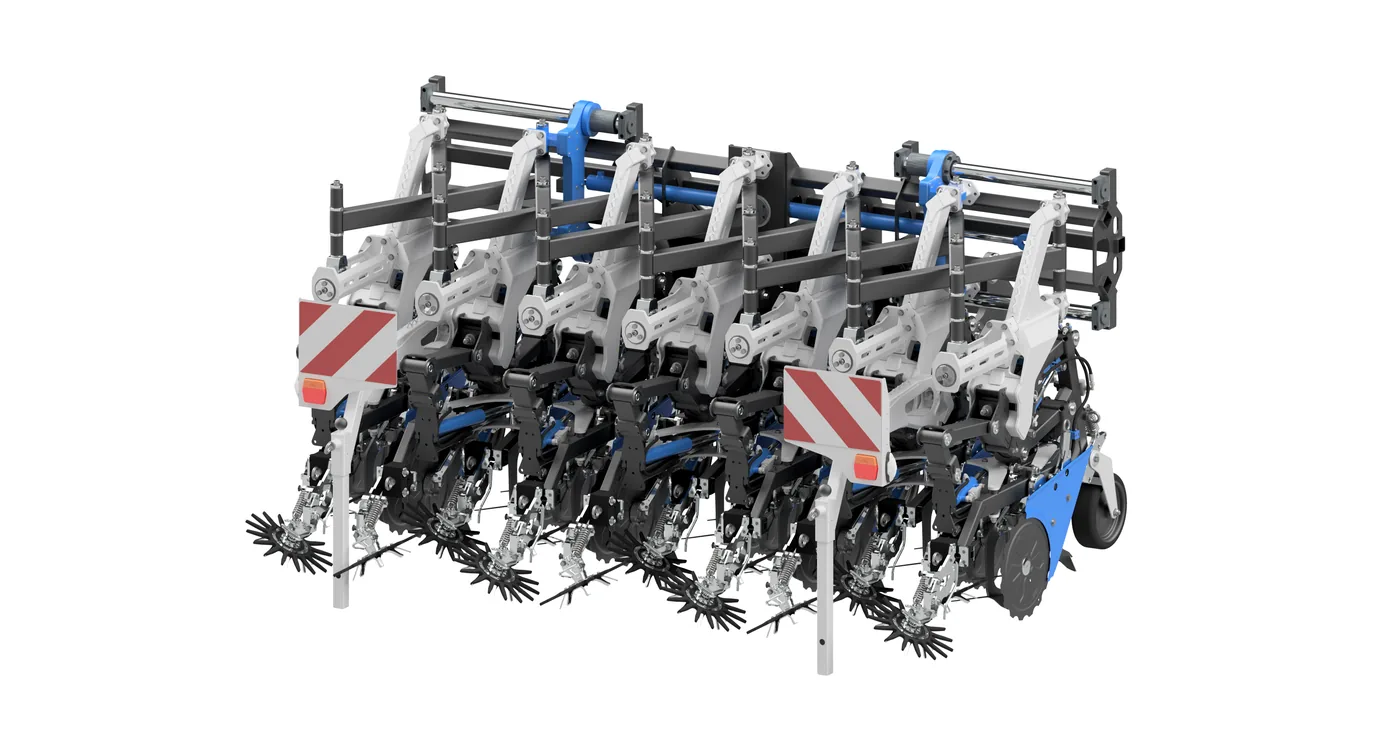
The third type works inside the row. A camera sits above every row, a 3D camera additionally measures height, and the blades open and close around each individual crop plant. On the VarioCHOP AI, the AI recognises the plant by its root rather than its leaves – so wind and overhanging foliage are not a problem – and actuates the blades up to three times per second. No calibration is required, work is possible day and night, and over 100 crops are supported; a new crop is typically learned in around six hours.
This technology replaces the hand labor that used to be left over: up to 90 percent of hand weeding costs are eliminated, and a six-row machine can replace up to 60 workers. If you want to understand the principle first, the basics are covered in our article on the in-row cultivator.
A fourth category deserves a mention for completeness: full-width implements. A universal cultivator such as the THOR controls weeds mechanically across the whole area and also covers seedbed preparation, stubble cultivation and incorporating cover crops – but it does not replace a row-crop cultivator in a standing crop.
The machine types compared
| Type | Field of use | Accuracy | Work rate | Typical crops |
|---|---|---|---|---|
| Standard cultivator (e.g. VarioCHOP) | Between the rows; row widths infinitely variable from 45 to 75 cm with X-ADJUST | Centimeter-accurate at the plant thanks to band width adjustment; guidance by flange wheel, feeler or driver | Up to 19 km/h; with a 3 m working width roughly 3–5 ha/h including headland turns | Corn, sugar beet, soybeans, pumpkin, sunflower, vegetables |
| Camera-guided between the rows | As above, plus automatic row guidance via a side-shift frame | The camera keeps the implement in the row; the row itself is not hoed | Base machine identical; the gain is consistent accuracy rather than higher speed | Row crops with narrow spacing, cross-slope work, large fields |
| In-row with AI (VarioCHOP AI) | Inside the row – either in-row only or in-row plus between the rows; 1 to 16 rows configurable, from 15 cm row spacing | Camera above every row, root detection, blades actuated up to 3 times per second; from approx. 8 cm spacing within the row | In six-row sugar beet up to 5 km/h and around 1 ha/h | Over 100 crops: sugar beet, corn, pumpkin, onion, garlic, lettuce, cabbage, herbs |
Which number of rows and working width fits your farm
The number of rows is not a free choice – it follows from your drilling equipment. If you sow six rows, you hoe six rows. Anyone hoeing with a different row count than they sow has to watch every tramline joint, and that is exactly where crop damage happens. So check the drill and the harvester first, and the cultivator second.
Row spacing by crop. Corn usually stands at 70 to 75 cm, sugar beet at 45 to 50 cm, soybeans between 30 and 45 cm, sunflowers at 50 to 75 cm, field vegetables at 30 to 50 cm depending on the crop, and oil pumpkin at 140 to 200 cm. If several of these crops are in your rotation, you need a machine that can make the switch. Crop-by-crop detail is in our guide to choosing the right row spacing.
Hectares and work rate. Calculate with the area that has to be covered per pass within a suitable weather window – not with the total farm area. A three-meter machine covers roughly 3 to 5 hectares per hour. One person handles 20 hectares of row crops in two to three days, whereas the same area by hand occupies two to three people for three to four weeks. An AI machine working in the row is slower – around one hectare per hour in six-row sugar beet – but it saves the follow-up hand work.
Tractor. There is no universal horsepower figure: it depends on weight, working width, soil type and whether the implement runs on the front or the rear linkage. Check the interfaces instead – headstock or side-shift frame, the number of double-acting spool valves required, visibility of the row and axle loads. For the AI technology the requirements are pleasantly modest: GPS is helpful but not necessary, ISOBUS is not mandatory, and power can be taken directly from the battery.
Field shape. Small, irregularly shaped fields argue for narrower, more manoeuvrable machines – the share of headland turning time grows with working width. Large, long fields justify wide, folding implements. On cross-slope work, look closely at guidance: a steering headstock that not only shifts the implement sideways but also angles it relative to the row prevents drift on slopes.
New or used: an honest comparison
The used market for cultivators is well stocked, and for many farms a used machine is the right call – particularly with smaller areas or where the implement will be shared between farms anyway. But there are points at which a used purchase turns out more expensive than expected.
| Criterion | New machine | Used machine |
|---|---|---|
| Capital tied up | Higher, but predictable over the service life | Considerably lower – the main reason to buy used |
| Eligibility for subsidies | Investment subsidies target new hoeing technology; in Lower Austria 20 percent on new hoeing technology is currently possible, and rates range from 15 to 40 percent depending on the programme | Usually not eligible, or only to a limited extent – clarify with the funding body before buying |
| Configuration | Row count, row spacing, headstock and accessories are matched to the farm | You buy the previous owner's configuration; conversions cost time and money |
| Camera and AI | Provided for from the outset: the VarioCHOP is designed to be combined with a camera system | Only sensible if the frame can carry the attachments and the manufacturer offers a retrofit |
| Wear | Shares, bearings and springs are new | Shares are wearing parts; a replacement set can account for a noticeable share of the purchase price |
| Availability | Allow for lead time, especially before the season | Available immediately – often the decisive argument mid-season |
| Service | Warranty, handover training, direct line to the manufacturer | Sold as seen; check spare parts supply in advance |
As a rule of thumb from practice, owning a cultivator pays off against pure hand labor from around 15 to 25 hectares of row crops per year. Below that, a machinery cooperative, a contractor or indeed a used machine are the more obvious routes.
Buying a used cultivator: what to look for
Wearing parts
Shares are the central working tool and at the same time a wearing part. A blunt share works less effectively and needs more draft. Look at how far the shares are worn down, whether they are all the same type, and whether they are simple versions or wear-resistant variants in Hardox or carbide. Also wearing parts: finger weeders, crop protection discs, depth wheels and the rubber on flange wheels.
Frame and suspension
The frame determines service life. Watch for bent tool bars, re-welded areas, worn pins and bushings on the parallelograms, and fatigued springs. Worn suspensions let the share units wander sideways – and that is precisely what destroys plants. Check whether all units can still be moved and clamped easily on the bar; seized clamps mean the machine can no longer be adapted to a different row width.
Hydraulics
On machines with a side-shift frame, folding or electrohydraulic adjustment, the hydraulics are the most expensive repair item. Have every function demonstrated while stationary: do the cylinders travel smoothly and without jerking? Do they hold position? Are hoses brittle, chafed or damp? How many spool valves are needed, and does that match your tractor?
Camera and AI technology: can it be retrofitted?
This is the question most often underestimated when buying used. A camera system can only be added sensibly where the frame provides for it and the manufacturer offers a matching solution – the VarioCHOP, for instance, is explicitly designed to be combined with a camera system. In-row hoeing with AI, by contrast, is not an accessory but a machine concept of its own, with a camera above every row, individual height control per row and its own controller. If you want that later, plan for it at the time of purchase rather than hoping for it.
Spare parts supply and year of manufacture
More important than the year of manufacture is whether the manufacturer still exists and whether wearing and spare parts are available. A ten-year-old machine from an active manufacturer with shares on the shelf is the better buy than a five-year-old machine nobody stocks parts for. Ask about the previous owner, the area worked per year, winter storage and documented repairs.
Inspection list for the viewing
- Shares: remaining material, consistent type, material – ask what a complete replacement set costs.
- Tines and springs: fractures, fatigued or re-tensioned springs, missing retainers.
- Parallelograms: check play in pins and bushings by hand – lift each unit individually and move it sideways.
- Frame: cracks, weld seams, distortion, corrosion at the clamping points.
- Adjustability: can row spacing, working depth and attachments be adjusted without force?
- Hydraulics: cycle every cylinder, check hoses and fittings for leaks.
- Guidance: flange wheels, depth wheels or camera – condition, bearing play, function.
- Electrics and terminal: present, working, operating manual included?
- Accessories: what comes with it – finger weeders, harrows, ridging discs, support wheels? What is missing and what does it cost new?
- Paperwork: previous owner's invoice, parts list, proof of repairs.
- Transport: transport width and height, lighting, folding locks.
- If at all possible: see the machine working in the field, not just parked in the yard.
Price range: what the price actually depends on
Serious price figures are difficult with cultivators because practically every machine is configured individually: row count, row spacing, headstock, per-row accessories and control system each move the price. So instead of list prices we cannot substantiate, here are the orders of magnitude and the factors that can be substantiated.
Order of magnitude. The purchase price of a cultivator is usually in the five-figure range. A useful lower marker comes from a side condition of the subsidy programmes: most require a minimum investment volume, frequently 5,000 to 10,000 euros net. Upwards the range is open – a simple frame machine with a few rows and an AI-controlled in-row machine with sixteen rows are in entirely different classes.
What pushes the price up:
- Number of rows and working width – the VarioCHOP AI can be configured from 1 to 16 rows.
- Folding capability and transport width on large working widths.
- Type of adjustment: mechanical band width adjustment, electrohydraulic adjustment from the cab, or infinitely variable row width adjustment from 45 to 75 cm.
- Headstock or side-shift frame: simple headstock, linear side-shift frame, or steering headstock with angle adjustment for cross-slope work.
- Per-row accessories: finger weeders, ridging and precision cutting discs, harrows, cutting discs, knife rollers, support and depth wheels. Our article on cultivator attachments and accessories gives an overview.
- Share quality – Hardox or carbide instead of a basic version.
- Camera guidance, Section Control and, above all, AI-based in-row hoeing.
What the machine costs in operation. For the buying decision, cost per hectare is often more informative than the purchase price. A cultivator incurs depreciation, fuel, an operator and maintenance – roughly 25 to 50 euros per hectare including tractor and driver, depending on farm size. Over a season with three passes that is about 3 to 5 machine hours and therefore around 75 to 250 euros per hectare. Pure hand labor runs to 60 to 90 working hours per hectare and season, which is 900 to 2,000 euros in wages per hectare.
Payback. From around 15 to 25 hectares of row crops per year, owning a machine clearly pays off against pure hand labor. One customer with roughly 15 to 20 hectares of organic sugar beet reports that his AI machine pays for itself in four years. Figures like these are farm-specific – recalculate them with your own hourly rates and your own area.
One practical note to close: a subsidy application generally requires several comparative quotations anyway. Use that mandatory step to create real price transparency – and insist that the quotations cover an identical configuration, otherwise you are comparing apples with oranges.
Subsidies: the step that comes before the purchase
Investments in mechanical weed control are supported by several programmes in Austria and Germany. Depending on the programme, farm size and federal state, subsidy rates run between 15 and 40 percent of eligible investment costs; in Lower Austria 20 percent on new hoeing technology is currently possible. In Germany, various federal states support mechanical weed control through GAK funds, state programmes and investment subsidies in organic farming.
The most important point is a matter of timing: the subsidy must be approved before the machine is bought. Anyone who buys first and applies afterwards generally forfeits the claim. Add to that a retention period – subsidised machines must stay on the farm for several years – and, depending on the programme, a minimum investment volume. If you are hoeing mechanically anyway, also check whether a matching agri-environmental measure applies, since ongoing payments shorten the payback period further. The details are in our guide to investment subsidies for hoeing technology.
Checklist before you buy
- Write down area and crops: how many hectares of row crops, which crops, how many passes per season?
- Note the row spacing and row count of your existing drill – the cultivator follows the drill, not the other way round.
- Decide whether you only need to hoe between the rows or inside the row as well.
- Check the time window: how much area has to be covered per pass, in how many days?
- Clarify the tractor interfaces: front or rear linkage, spool valves, power supply, visibility of the row.
- Take field shape and slopes into account – these determine working width and type of guidance.
- Put together the accessories you need per crop and have them quoted, rather than buying them later.
- Ask specifically about conversion time between two crops and time it yourself at a demonstration.
- Clarify subsidies in advance and submit the application before the purchase.
- Obtain several comparative quotations covering an identical configuration.
- Check spare parts supply, service availability during the season and response times.
- See the machine working before you decide – on your own soil, in your own crop.
Frequently asked questions about buying a cultivator
What does an inter-row cultivator cost?
The purchase price is usually in the five-figure range, but the spread is wide: row count, working width, type of adjustment, headstock, per-row accessories and any camera or AI control determine the price. More informative for the buying decision are the running costs – roughly 25 to 50 euros per hectare including tractor and driver.
Is a used cultivator worth it?
With smaller areas, with shared use between farms, or when a machine is needed at short notice: yes. Arguing against a used purchase are the usual lack of subsidy eligibility – investment subsidies target new hoeing technology – the previous owner's fixed configuration, and the cost of replacing wearing parts. Always add the price of a complete set of shares and any missing accessories to the purchase price.
What should I check particularly carefully on a used cultivator?
Worn pins and bushings on the parallelograms, bent or re-welded frames, fatigued springs, seized clamps on the tool bar, and the condition of the hydraulics. And whether wearing parts for that model are still available at all.
How many rows do I need?
The same number as your drill. Anything else causes problems at the tramline joints. Working width is decided by field shape and time window: a machine with a 3-meter working width covers roughly 3 to 5 hectares per hour including headland turns.
Can camera technology be retrofitted?
Camera guidance for row following can be retrofitted if the frame is designed for it – the VarioCHOP, for example, is intended to be combined with a camera system. AI-based hoeing inside the row, by contrast, is not a retrofit kit but a machine concept of its own, with a camera above every row and its own controller.
From how many hectares does owning a cultivator pay off?
As a rule of thumb from around 15 to 25 hectares of row crops per year, provided you farm the area yourself and use the machine for several passes per season. Below that, a machinery cooperative, a contractor or a used machine are usually the more economical routes.
Are there subsidies for buying a cultivator?
Yes. Depending on the programme, federal state and farm size, rates run between 15 and 40 percent; in Lower Austria 20 percent on new hoeing technology is currently possible. The order matters: application and written approval first, purchase second. A retention period usually applies as well.
Do I need GPS or ISOBUS on the tractor?
Not necessarily for the AI-based in-row technology. GPS is helpful but not required, ISOBUS is not a prerequisite, and power can be taken directly from the battery.
The last step: compare in the field
Data sheets and brochures say little about how a machine penetrates heavy soil, how good the view of the row is, and how long converting from one crop to the next really takes. Once you have a shortlist, see the candidates at work – ideally in your own crop and at your own row width. Current dates are listed on our demonstration page; if you have questions about the choice of machine or about subsidy eligibility, we are happy to answer them directly and without sales pressure.